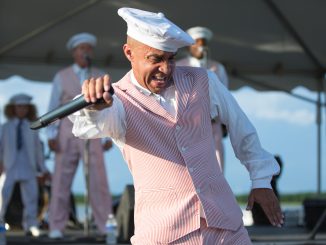
GREENSBORO — Trying to pin Hiss Golden Messenger to a single genre has never really worked, and that resistance to easy definition has always been part of the appeal. Folk, gospel, rock, jazz, roots, Americana and country all surface throughout the Durham-based band’s catalog, sometimes within the same song. At the center is founder, singer and songwriter Mike “M.C.” Taylor, whose writing and evolving cast of collaborators have turned the project into one of North Carolina’s most venerable musical collectives — one that has grown from small rooms to national stages and a Grammy nomination for best Americana album.
That elasticity is intentional. When I interviewed Taylor in 2020, he acknowledged that even he struggles to explain what Hiss Golden Messenger “sounds like,” and said that ambiguity has always been part of the point.
“I have a hard time explaining what Hiss Golden Messenger sounds like too,” Taylor said at the time. “That’s intentional. I want to be part of the creation of things that are hard to explain. All of my favorite art has many layers and isn’t meant to be understood on first listen or viewing.”
For me, the band is inseparable from a specific moment — dare I say a “golden age” — of music in the Triangle. Anyone living in Raleigh and the surrounding area between 2004 and 2010 witnessed what felt like a particularly fertile stretch. The Rosebuds, The Comas, The Old Ceremony, Hammer No More the Fingers and The Proclivities — to cite a mere smattering — were steady presences on small stages across the region. Most weekends, I could be found at King’s in Raleigh, Local 506 on the edge of Chapel Hill or Cat’s Cradle in Carrboro. There was a creative momentum during that period that hasn’t quite resurfaced in the same way.
What caught my attention early on — and holds it to this day — was and is the participation of madman guitarist and local legend Chris Boerner. Long before Hiss Golden Messenger reached a wider audience, Boerner was already a familiar and respected figure locally — a guitarist, producer and recording engineer whose work moved easily between bands including The Hot at Nights, The Proclivities and The Foreign Exchange. His involvement reflected how that Triangle scene functioned, with musicians shifting roles and projects as a matter of course.
The first time I saw Hiss Golden Messenger perform in Raleigh was around 2007, when the project was just beginning to take on collaborators beyond Taylor. The crowd numbered fewer than 40 people. There was no sense then of where the project would eventually land — only that it felt connected to a broader calling, with musicians like Boerner, Matt Douglas and Durham native Phil Cook already part of the orbit, either onstage or later in the studio.
That flexibility continues to define the band. More than a dozen albums and a constantly revolving cast of studio and stage collaborators later, Hiss Golden Messenger remains anchored by the lyrical musings of Taylor — part-time tortured poet, part-time picture of jubilation and a full-time showman whose changing bandmates are baked into the evolution of the sound itself.
That current iteration will be on display again Saturday, Jan. 17, when Hiss Golden Messenger takes the stage at the Steven Tanger Center for the Performing Arts backed by the Greensboro Symphony Orchestra.
The orchestral program debuted last September with the Colorado Symphony and expands the band’s material without reshaping it. Boerner said the goal was never reinvention, but space. The arrangements, written by Charleston-based composer Jay Clifford, were built around live recordings rather than studio tracks, allowing the band to perform much as it normally would, with the orchestra filling in around them.
“It really brings in another layer,” Boerner said. “As a musician, it was one of the greatest experiences of my career.”
What struck him most was how naturally the collaboration came together. Because the charts were drawn from live performances, the band didn’t have to rethink its approach onstage.
“We could just show up and do what we normally do,” he said. “The orchestra expands the sound around us instead of forcing the songs into something else.”
Leading the Greensboro Symphony will be Christopher Dragon, who also conducted the Colorado performances. Boerner said that continuity helps the collaboration move quickly. Greensboro audiences have seen this kind of translation work succeed before, including Gregory Alan Isakov’s orchestral appearance at the Tanger Center — an example of how songwriter-driven music can adapt to a larger setting without losing its shape.
The current touring lineup includes Taylor and Boerner alongside keyboardist Rhett Huffman, a Burlington native formerly of American Aquarium; drummer Matt McCaughan, whose long association with Taylor spans studio and touring work and includes collaborations with Lambchop and Bon Iver; and bassist Cameron Ralston, a Richmond-based musician with deep ties to North Carolina through his ongoing projects with Taylor. Additional musicians may join the ensemble for the orchestral performance.
For Taylor, that rotating cast — and the personalities they bring — remains central to the project.
“I’m looking for kind people that have confident and recognizable voices on their respective instruments,” he told me in 2020. “I don’t necessarily need technical virtuosos, but I want players whose personalities you hear when they play.”
That approach now arrives in Greensboro, backed by a full orchestra and a room built for scale — another chapter in a project that has never stayed still for long.