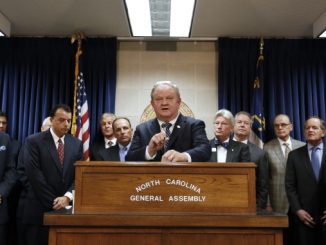
RALEIGH — Seats on North Carolina’s two top courts will be on the ballot in 2026: one on the Supreme Court and three on the Court of Appeals. All four seats are currently held by Democrats.
For both courts, judges are elected statewide and serve eight-year terms.
On the North Carolina Supreme Court, Democratic Associate Justice Anita Earls is facing her first reelection bid since winning the seat against incumbent Republican Associate Justice Barbara Jackson in 2018 by more than 15% of the vote.
But Jackson wasn’t the only Republican on the ballot; she was joined by Chris Anglin, who registered as a Republican 11 days before filing to run for the seat. His campaign was run by longtime Democratic political operative Perry Woods, and he drew enough votes off Jackson for Earls to win.
During her 2018 run, Earls was backed by former President Barack Obama’s U.S. Attorney General Eric Holder, who traveled to North Carolina on at least one occasion to campaign for her. Obama and Holder’s National Democratic Redistricting Committee dropped half a million dollars into the North Carolina Democratic Party’s coffers in 2018 but only donated to and endorsed one North Carolina candidate, Earls.
Along with then-Attorney General Josh Stein, Earls was tapped by former Gov. Roy Cooper to co-chair his Racial Equity in Criminal Justice task force. Cooper’s task force has been used in early campaigning for next year’s U.S. Senate race by Republican Michael Whatley as evidence of Cooper’s “soft on crime policies” while governor in the state.
Earls will face North Carolina statehouse Rep. Sarah Stevens (R-Surry), who announced her bid to unseat Earls in May.
On the North Carolina Court of Appeals, there are three seats on the ballot:
Collins announced in a LinkedIn post in late May that she will not be seeking reelection.
Two Democrats, James Whalen and Christine Walczyk, have indicated they will run for Collins’ seat.
Whalen was one of the attorneys representing Associate Justice Allison Riggs during her 2024 election legal battles. Walczyk, who has already grabbed an endorsement from former N.C. Supreme Court Chief Justice Cheri Beasley, is a Wake County District Court judge.
After sweeping statewide judicial races in 2020 and 2022, Republicans currently hold a 5-2 majority on the Supreme Court and an 11-4 majority on the Court of Appeals.
The high court maintained the 5-2 majority during the 2024 election cycle when Riggs was declared the winner against Republican Jefferson Griffin, a Court of Appeals judge, after a lengthy legal battle. Riggs won by 734 votes, or 0.02%.
Riggs was an attorney for the Southern Coalition for Social Justice when Cooper appointed her to the appeals court on Dec. 15, 2022. Before Earls’ run in 2018, she and Riggs were partners at that firm.
In September 2023, Cooper elevated Riggs to the Supreme Court to fill the seat of Democrat Mike Morgan, who left the bench to embark on a 2024 gubernatorial bid.
During the 2022 Supreme Court seat elections, Republicans Richard Dietz and Trey Allen beat Democrats Lucy Inman and Sam Irvin by around 5% of the vote in each race. Irvin was a first-term incumbent associate justice who took office in 2016.
For the 2022 Court of Appeals seats, Republican Julie Flood beat Democrat Carolyn Thompson, appointed by Cooper to fill Riggs’ seat. Republican Michael Stading defeated Democrat and former legislator Darren Jackson. Additionally, incumbent Court of Appeals Republicans Donna Stroud and John Tyson were reelected.
The 2020 election saw Republicans win all five Court of Appeals seats on the ballot. Republican winners who were new to the court included April Wood, Fred Gore, Jeff Carpenter and Griffin. Incumbent Court of Appeals judge Chris Dillon also secured reelection that year.
Also in 2020, Republicans won all three of the seats on the ballot that year, including Republican Paul Newby defeating Cooper-appointed Democrat Cheri Beasley for the chief justice spot.
Newby was declared the winner after Beasley conceded following a series of election challenges, and he was installed as the state’s 30th chief justice on Jan. 1, 2021.
The other two seats were won by Republicans Tamara Barringer and Phil Berger Jr., who defeated their Democrat opponents Mark Davis and Lucy Inman, respectively.
Statewide judicial races in North Carolina over the decades have been both partisan and nonpartisan.
When Republicans began winning more judicial races under the partisan ballot labeling structure during the late ’90s through 2002, Democrats, who controlled the General Assembly at the time, changed laws to make the races nonpartisan.
That change was reversed after Republicans took majorities in both chambers following the 2010 Tea Party wave. The judicial races became partisan again through House Bill 100, a 2017 measure passed by the General Assembly and later enacted after overriding Cooper’s veto.
Earls’ 2018 election was the first partisan state Supreme Court election since 2002.