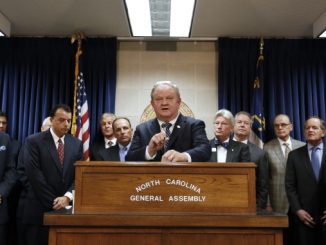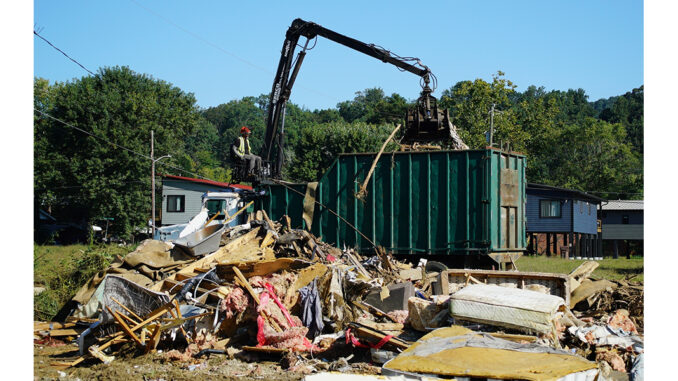
RALEIGH — A Joint Legislative Commission on Governmental Operations’ subcommittee hearing held last week focused on a recent state audit report of former Gov. Roy Cooper’s hurricane relief and recovery office.
The hearing was held at Harvey Hall in the Murphy Center, located on the campus of East Carolina University in Greenville.
Testimony and presentations were provided by State Auditor Dave Boliek and Pryor Gibson, director of the North Carolina Office of Recovery and Resiliency (NCORR). The meeting was chaired by Rep. Karl Gillespie (R-Macon) and Sen. Brent Jackson (R-Sampson).
NCORR has been the topic of multiple legislative hearings over the past three years due to the slow home rebuilding and recovery following Hurricane Matthew (2016) and Florence (2018).
Gibson took over NCORR last November after Director Laura Hogshead abruptly left just two days after lawmakers grilled her about continued lack of progress in getting hurricane victims back in homes. Earlier this year, Gibson faced lawmakers during a sometimes contentious hearing in the aftermath of Hogshead’s departure. It remains unclear if Hogshead resigned or was fired.
Boliek’s presentation and remarks, which lasted more than an hour, took up the bulk of the meeting. Boliek laid out the key findings of the audit on NCORR, which had been unveiled the day before during a press conference.
The audit cited NCORR having managed more than $1 billion in combined federal and state funding: $709 million from the federal Community Development Block Grant (CDBG) and $297 million from state appropriations.
The applications and grant activities were tracked using Salesforce, with NCORR having spent more than $25.4 million on “design and implementation of the Salesforce platform.”
Of the 11,654 applications received, 4,302 were listed as active and 4,331 were withdrawn. More than 1,400 projects were found to be duplicates in the Salesforce system data, and nearly 1,500 applications were deemed ineligible.
The audit also noted that the application period closed on April 21, 2024, and 3,522 projects had been completed as of a year later.
A key finding was the lengthy application process, which had eight steps and, on average, took 936 days — more than 2½ years — to complete all eight. Additionally, construction projects did not begin until an average of four years after homeowners were found eligible.
“That’s just too long,” Boliek told lawmakers. “We cannot put process above outcomes.”
Boliek said more than $74.4 million was spent on temporary relocation assistance, noting in his presentation that some families remained in temporary housing for over 1,400 days, “incurring lodging costs exceeding $230,000 for a single household.”
Boliek also said the investigation into NCORR’s Homeowner Recovery Program (HRP) — which included bringing in Craig Fugate, the former Federal Emergency Management Agency administrator — revealed the “worst government program they’ve ever seen.”
During testimony, Boliek walked up to a table with rows of boxes he said were filled with the contracts entered by NCORR, calling it “bureaucracy at its worst.”
The audit also found NCORR’s financial commitments exceeded funds available, and the office “did not know the full cost of recovery until after the application period closed.” Poor budgeting and data management practices as well as poor data quality were also cited as problems.
Overcommitment of funding resulted in a $297 million shortfall, which had to be remedied by the legislature.
Rep. Eric Ager (D-Buncombe) asked about the timing of the audit, to which Boliek responded that he didn’t feel comfortable releasing it earlier, saying, “I’ll take the hit on that.”
“The goal is to get a true picture,” Boliek said, later adding, “This is not a ‘point your finger’ audit. This is a ‘how can we move forward?’ audit.”
Gibson’s presentation included an example of a project status breakout for Columbus County that he said was helpful in working with local governments.
Gibson thanked legislators for the funds they have put into NCORR’s efforts, as well as calling work by local governments and nonprofits in eastern North Carolina “amazing.”
Gibson agreed with Boliek that the number of contracts was an “indication of how complicated this process can be,” but he also said it was all part of the compliance process.
Gibson said 50-60 home completions a month is good “but not good enough,” and it was NCORR’s intention to be finished by the October 2026 deadline. He said that as of the end of this October, 92% of projects were completed, 9% were in construction and 2% were waiting to get into construction.
Gibson also said Gov. Josh Stein’s new recovery office, NC GROW, has been given “all the lessons learned from eastern N.C. recovery” to help it avoid the same mistakes NCORR made.
“Since you’ve been at NCORR, the tide has turned,” Jackson said to Gibson at the conclusion of the meeting.