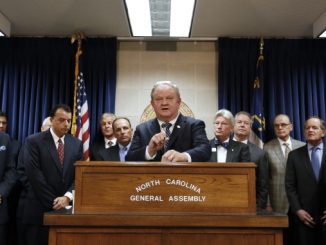
RALEIGH — Officials with Winston-Salem/Forsyth County Schools told a state board of education appeals panel that the district’s $3.4 million debt to the North Carolina Department of Public Instruction is “paid in full” during a hearing last Tuesday.
The hearing was a follow-up to a Sept. 2 meeting, at which the appeals panel extended the grace period on the $3.4 million Winston-Salem/Forsyth County Schools (WS/FCS) owed to the N.C. Department of Public Instruction (NCDPI).
WS/FCS overall budget deficit was found to be more than $46 million, according to a state audit.
The three-member panel was chaired by John Blackburn, who was joined by State Board Chair Eric Davis and board member Jill Camnitz.
“As of Oct. 28, we have paid DPI in full,” said WS/FCS School Board Chair Deanna Kaplan. “The final $3.4 million payment was funded by the Winston-Salem Foundation’s Winston Salem-Forsyth County Schools Futures Fund.”
The full repayment of the debt to NCDPI avoids the district having to pay 0.4% interest on any unpaid balance.
“Leaders in the Forsyth County community rallied around Winston-Salem/Forsyth County Schools and they led a fundraising effort to support our schools and our students,” Kaplan said, adding
the fund is raising money specifically for paying off the debt and fundraising is still ongoing.
Kaplan presented the district’s debt repayment plan alongside interim WF/FCS Superintendent Catty Moore and School Board Vice Chair Alex Bohannon.
“Through Dec. 31, every private dollar spent towards reducing the district’s debt will be matched in debt forgiveness by the county,” Kaplan told the panel. “The payment made by the Futures Fund to DPI last week will also reduce our debt to the county by $3.4 million. So that leaves our current debt to the county at $1.6 million.”
WS/FCS’s estimated debt was $46.1 million for FY 2024-25, and the presentation given by Kaplan listed total debt to its three largest vendors of more than $15.377 million, broken down by vendor, the district owes ESS (substitute staffing service) more than $6.1 million, Forsyth County more than $5 million and SSC (custodial services) more than $4.25 million.
Kaplan said they renegotiated the SSC contract to “satisfy our outstanding obligation.” The new 10-year contract will begin Jan. 1, 2026, and comes with a “$4.2 million signing bonus.” She also said the new contract saves the district $1.2 million this year and more than $2.14 million in future years.
“These efforts have resolved more than $22 million of our total debt. This leaves our remaining debt to vendors at $7.7 million,” said Kaplan, adding that continued fundraising will hopefully eliminate the remaining debt to the county.
Kaplan said WS/FCS’s repayment plan will be a “multiyear effort,” including a goal of identifying $3.5 million in revenues for additional debt repayment within the current fiscal year and an eye on repaying $2 million to the Child Nutrition Loan Fund.
Kaplan told the panel that personnel changes were made to ensure they were more “closely aligned with state allotments,” and that they have a “balanced budget for this fiscal year.”
WS/FCS’s fiscal year budget for 2025-26 includes a resolution for $3.5 million in debt repayment and a $2.1 million reserve fund for “overages” that could be used to pay down the debt.
“We propose that next fiscal year we will set aside $4.2 million for debt repayment when we adopt the budget,” said Kaplan, who described monthly payment plans for the vendors, which includes $375,000 to ESS, $125,000 to Child Nutrition and a to-be-determined amount to the county.
Kaplan said should fundraising efforts fail to materialize, debt repayment to the county could be deferred. She also said $350,000 in the 2026-27 budget would be set aside for debt repayment. Kaplan indicated they expect to pay off the debt to ESS by July 2027.
Bohannon gave updates on the financial statement audit for last fiscal year performed by Forvis Mazars, which “will be substantially completed by Dec. 31” but won’t be finalized until after the state board’s internal controls review concludes.
Bohannon also gave an update on WS/FCS issues pertaining to IRS penalties.
“We are up to date on all federal withholding payments,” Bohannon said, but he noted errors were found in that area in payments to the state while reconciling the accounts.
Bohannan said a “leadership transition” in the district’s payroll department initially hampered efforts to straighten out what the district may or may not owe to the IRS.
During a question-and-answer period, Davis asked for clarification on the IRS issues.
“We are caught up, and actually we’re showing we’ve overpaid,” Moore replied, adding the district is trying to negotiate with the agency and are having to reconstruct documentation and payments back to 2021 so the IRS and district could agree what is or isn’t due. Moore also gave an example of a $450 penalty that “came off the books just through a phone call.”
Bohannan also recapped “accountability” efforts to prevent a debt issue in the future, including reviewing monthly financial reports, and the board is considering creating a new audit committee.