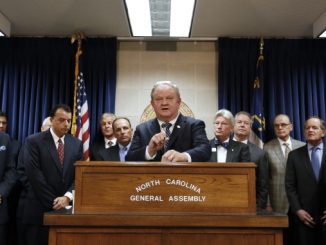
RALEIGH — The North Carolina General Assembly concluded its October session without passing a full budget, but it did send another minibudget to Gov. Josh Stein, who signed the measure Thursday.
Continuing Budget Operations Part IV (Senate Bill 449) is 17 pages long and contains funding priorities such as extending bridge loans for businesses impacted by Hurricane Helene from 12 to 24 months and directing the state treasurer to modify the Cashflow Program so loan repayments can be made after FEMA reimbursement payments are received.
The bill contains another $12 million for repairing fiber optic and broadband systems damaged by Hurricane Helene.
Under education, tuition for out-of-state students will increase from $2,500 to $3,500 per semester starting in the 2026-27 school year at NC Promise universities, which include Elizabeth City State, Fayetteville State, UNC Pembroke and Western Carolina. While attendance has increased at those schools in recent years, the NC Promise Program has been running at a deficit and is expected to have a $3.3 million shortfall next year, according to data presented during a UNC System Board of Governors meeting.
The bill also allocates $25 million in nonrecurring funds from the General Fund to the Pay Plan Reserve beginning in 2025-26. Other key spending items include:
- $300,000 to the Office of the State Fire Marshal to support three administrative positions
- $600,000 to hire more special assistant U.S. attorneys
- $700,000 for five full-time hires to the Environmental Management Commission
- $1.5 million to the Department of Agriculture and Consumer Services to support 10 full-time Veterinary Division positions
- $2 million for radios and equipment for the State Bureau of Investigations
- $2.1 million to the State Highway Patrol for maintenance of the VIPER emergency radio network
- $2.5 million to the General Assembly for the NCGA Special Police
- $3 million for avian flu response
- $7.2 million for technology and systems upgrades for the state’s court system
- $7.5 million for State Fairground repair/renovation projects to be drawn from fair receipts
- $20.85 million for replacement of the state’s Integrated Budget Information System
The two legislative chambers have been at an impasse on passing a final budget involving disagreements over tax policies and certain project spending. And that final budget may not come this session.
During the House session on Oct. 22, House Speaker Destin Hall (R-Granite Falls) indicated there may be no more votes taken during the current long session.
“Right now, though, the chair does not anticipate there being any recorded votes in the House for the remainder of this year,” said Hall. “But watch your email. That’s subject to change.”
Veto overrides, which have been on the House calendar for months, are nearing their Dec. 31 end date for action.
The pending veto overrides include two house bills — the Educational Choice for Children Act (ECCA) and Equality in State Agencies/Prohibition on Diversity Equity, and Inclusion (DEI) — and three Senate bills — Freedom to Carry NC, North Carolina Border Protection Act, Eliminating “Diversity, Equity, and Inclusion (DEI)” in Public Education, and Eliminating “Diversity, Equity, and Inclusion (DEI)” in Public Higher Education.
Unfinished business
Beyond the budget and the minibudgets that have been enacted, the legislature has other unfinished business, including Medicaid rebase funding and salaries for state employees.
Both chambers passed their own version of a Medicaid rebase bill last month, but neither chamber took up the other’s bill. The House’s version was Senate Bill 403, and the Senate’s was House Bill 562.
This month, the House’s passed another Medicaid rebase bill (House Bill 491), along with the Healthcare Investment Act (Senate Bill 405). Between the measures, the total recurring appropriations to the Medicaid rebase comes to $690 million.
“Gov. Stein has the money to keep Medicaid fully funded until April, yet he’s chosen to play politics with people’s healthcare by unnecessarily cutting rates,” Hall said in a press release. “We’re ready to work with the Senate — and anyone serious about solutions — to end Stein’s manufactured Medicaid crisis.”
The Senate’s “Back the Blue Pay Act” (House Bill 42) and Defund Planned Parenthood (House Bill 192) were passed in September by that body but remain unpassed by the House.
During the October session, the House passed its own bill blocking Medicaid funding (Senate Bill 378) from going to Planned Parenthood, as well as its own salary bill (Senate Bill 599) funding teacher and state employee salaries along with a law enforcement bonus. The Senate had shown no indication it would take up either of the bills.
In a joint Oct. 22 press release, Senate Appropriations Chairmen Brent Jackson (R-Sampson), Ralph Hise (R-Mitchell) and Michael Lee (R-New Hanover) urged the House to pass those two bills, stating, “It’s time to stop playing politics and come to the negotiating table.”
Tensions between the two chambers increased on Thursday following a press release by the Senate announcing the return of the House’s four bills as “ineligible” under the “agreed-upon adjournment resolution set by both chambers.”
“This stunt by the House is something we have never seen before — manipulating rules the House and Senate previously agreed to instead of simply taking up eligible bills already passed by the Senate that would address the Medicaid rebase, defunding Planned Parenthood and providing pay increases for law enforcement,” said Senate Rules Chairman Bill Rabon (R-Brunswick). “Such gamesmanship is not a serious effort to solve the issues facing our state and should be viewed as such.”
Under the adjournment agreement referred to by the Senate, the only bills eligible for consideration are redistricting, conference reports with previously appointed conferees, bills returned for concurrence on or before Sept. 25, joint adjournment resolutions and vetoed bills.
The House had altered the adjournment resolution allowing for such bills to be filed, but the Senate had already finished business and left town, therefore, there was no concurrence made on the House changes.
It may be likely that the House ran its own legislation because the Senate’s versions were not clean bills, one example being funding for the UNC Children’s Hospital added into the Senate’s Medicaid rebase proposal. Another example would be the addition of “fairness in billing and collections” by hospitals, which was added to the Senate’s bill blocking Medicaid money from going to Planned Parenthood.
House Minority Leader Robert Reives (D-Chatham) picked up on the discord between House and Senate Republicans and in a statement said, “Republican leaders in Raleigh are reaching new depths of dysfunction, now even refusing to accept legislation passed from one chamber to the other.”
The House has not yet issued a statement in response to the Senate returning the bills.